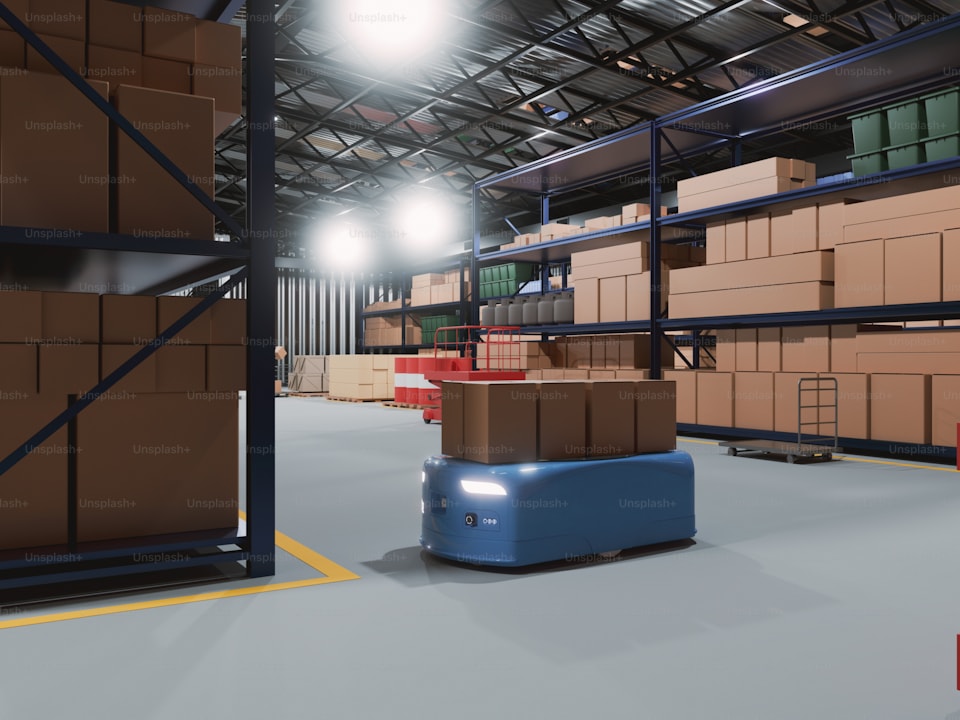
Modern distribution centers and factory floors demand more from autonomous vehicles than any other environment. Traffic is dense, routes change daily, humans share the space, and a navigation error doesn’t just cause delay — it causes injury, damage, or a production halt. Conventional AGV guidance relies on floor tape, magnetic strips, QR codes, or expensive LiDAR maps that require constant re-calibration when the layout changes. Beluga Navigation Systems replaces fragile physical markers and costly sensor stacks with active digital infrastructure that guides any vehicle — forklifts, tuggers, AMRs, or custom platforms — with millimeter accuracy and zero floor modification.
The Problem with Today’s Industrial Navigation
Floor tape gets torn up by forklifts and pallet jacks. Magnetic strips require concrete cutting to install. LiDAR-based navigation demands detailed, up-to-date maps of every aisle, shelf, and obstacle — and any warehouse reorganization means a re-mapping project. QR code grids need cameras that fail under dust, poor lighting, and pallet wrap reflections.
Every one of these approaches shares the same weakness: they rely on the vehicle to perceive and interpret the environment. Beluga’s BIDAR™ protocol inverts this — the environment actively communicates with the vehicle. GRGuide beacons placed at intersections, dock doors, staging areas, and hazard zones tell approaching vehicles exactly where they are and what to do next, in real time, with no perception required.
Applications
- Autonomous forklifts and reach trucks — navigate narrow aisles and pick faces with millimeter precision, with aisle-entry beacons enforcing speed limits and directional rules without floor infrastructure
- Tugger trains and tow vehicles — follow defined route corridors across large factory floors, receiving turn-by-turn waypoint instructions from GRGuides at each junction
- Autonomous Mobile Robots (AMRs) — augment onboard mapping with reliable fixed-point corrections at critical locations: charging stations, pick stations, conveyor handoffs, and elevator lobbies
- Automated Guided Vehicles (AGVs) — replace tape and magnetic strip guidance with flexible, reconfigurable GRGuide layouts that can be redeployed in minutes when the workflow changes
- Cross-dock and sortation systems — assign and update vehicle routing dynamically at junction beacons without reprogramming the vehicle fleet
- Mezzanine and multi-level facilities — guide vehicles through lift entries, ramp transitions, and level changes with position-keyed speed and steering commands
How GRNav & GRGuide Work on the Factory Floor
Short-Range GRGuide beacons are compact, self-adhesive, and battery-powered — deployable in minutes on shelving uprights, overhead structures, door frames, or floor stanchions without any wiring or floor penetration. Battery life under non-continuous use can exceed two years. A vehicle’s GRNav module picks up each beacon as it approaches, receiving 1 mm positioning accuracy and navigation commands specific to that location.
When a layout change happens — a new racking row, a relocated charging station, a temporary restricted zone during a safety incident — you move the GRGuides. No re-mapping, no tape removal, no software re-deployment to the fleet. The vehicles adapt automatically as they encounter updated beacon positions.
Safety and Mixed-Traffic Environments
Industrial environments are not exclusively autonomous. Forklifts operated by humans, pedestrian traffic, and service vehicles share the same aisles. GRGuides at intersection entry points can issue mandatory slow-speed commands to any GRNav-equipped vehicle approaching a pedestrian crossing zone, regardless of what the vehicle’s onboard system believes about the route ahead. This provides a hardware-level safety enforcement layer independent of the vehicle’s software stack.
Integration
GRNav integrates with vehicle control systems via serial protocol and is compatible with common industrial automation interfaces. For fleets managed by a Warehouse Management System (WMS) or Fleet Management System (FMS), GRGuide beacons can be updated remotely to reflect real-time routing decisions made upstream — creating a closed-loop system where the WMS directs traffic not just through the software but through the physical infrastructure itself.
Building or upgrading an autonomous vehicle fleet for your facility? Let’s talk about your environment.
Contact Us →